Turkish dramas and Korean dramas have each built devoted international audiences, and many fans of one end up curious about the other. On the surface they share plenty: glossy production, emotional romances, families who interfere, and a love of the dramatic confession. Underneath, though, the two industries work in very different ways, and those differences change what it feels like to watch.
This guide compares the two across seven practical areas so you can decide where to start, or understand why one feels so different after enjoying the other. We use the word "typically" throughout, because both industries are diverse and there are exceptions to every rule.
Quick comparison
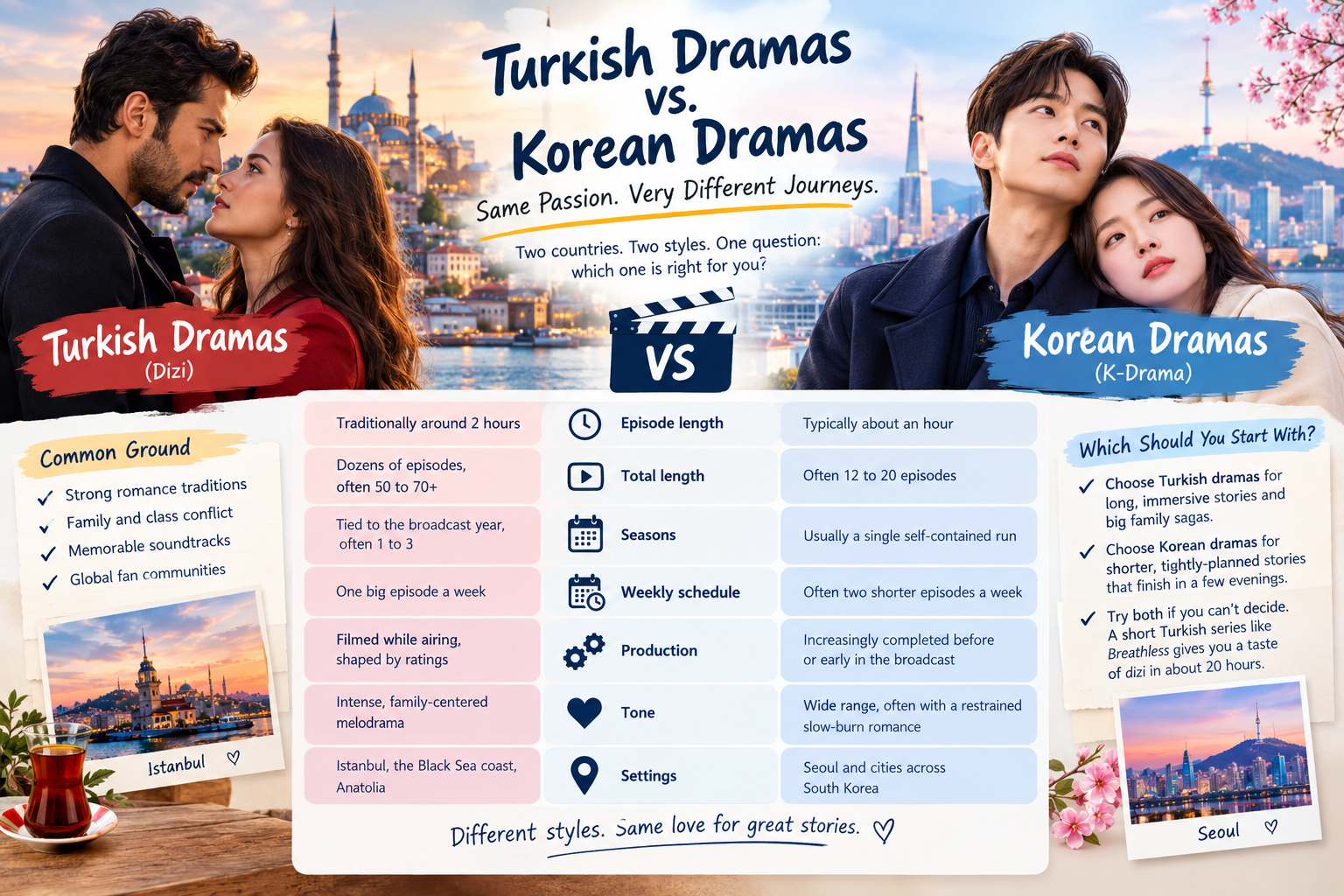
| Area | Turkish dramas (dizi) | Korean dramas (K-dramas) |
| Episode length | Traditionally around 2 hours | Typically about an hour |
| Total length | Dozens of episodes, often 50 to 70+ in total | Often 12 to 20 episodes |
| Seasons | Tied to the broadcast year, often 1 to 3 | Usually a single self-contained run |
| Weekly schedule | One big episode a week | Often two shorter episodes a week |
| Production | Filmed while airing, shaped by ratings | Increasingly completed before or early in the broadcast |
| Tone | Intense, family-centered melodrama | Wide range, often with a restrained slow-burn romance |
| Settings | Istanbul, the Black Sea coast, Anatolia | Seoul and cities across South Korea |
1. Episode length and total commitment
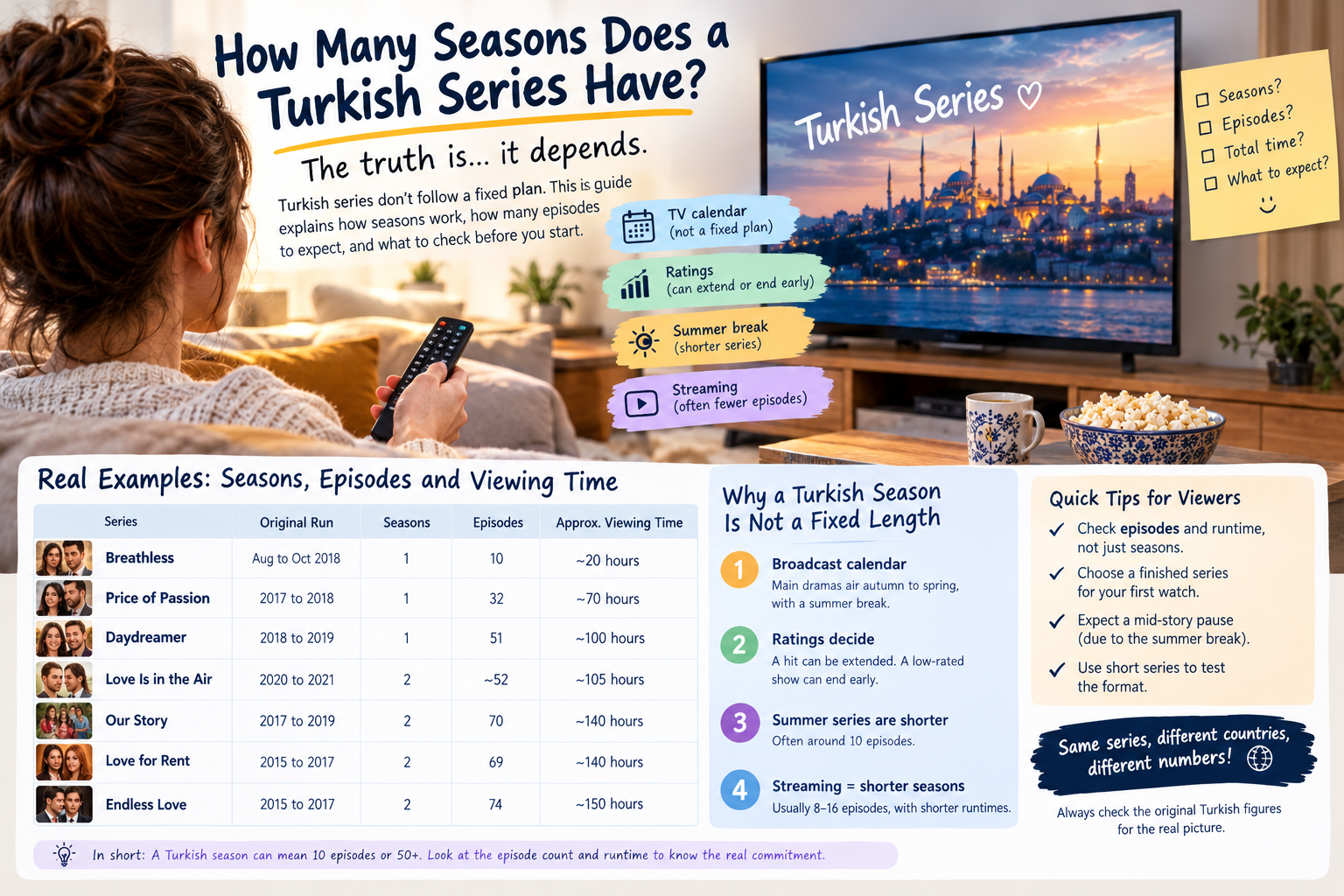
The most noticeable difference is how much time a series asks for. A single Turkish episode often runs about two hours, so even a "short" Turkish series can match the viewing time of a long Korean one. Breathless has only 10 episodes but takes around 20 hours to watch, while a full run like Love for Rent comes to roughly 140 hours across 69 episodes. A typical Korean miniseries of 16 hour-long episodes takes closer to 16 hours.
If you are curious about the reasons for the Turkish format, read our explanation of why Turkish drama episodes are so long.
2. Seasons and endings
Korean dramas are usually planned as one complete story with a fixed number of episodes, and a second season is the exception. Turkish series are structured around the broadcast calendar, so a story may be split into seasons that pause for summer and resume in the autumn. That affects how endings feel. A Korean drama is written toward a planned finale, while a Turkish drama may be extended or shortened as it airs. We explain this in detail in our guide to how many seasons Turkish series have.
3. Weekly schedule and the viewing habit
Turkish audiences traditionally gather for one major episode each week, which makes the show a weekly event. Korean broadcasts more commonly run twice a week with shorter episodes, which suits a quicker rhythm of discussion. For international viewers who stream a finished series, this matters less, but it explains why Turkish episodes feel like events and Korean episodes feel like chapters.
4. How the shows are produced
Turkish productions generally film continuously while the series airs, delivering a full-length episode every week. Endless Love director Hilal Saral told Drama Quarterly that her team shot about 150 minutes of finished material in five days. Because the show is being made on the fly, writers can respond to ratings and audience reaction. Korean productions increasingly finish much more of the series before it airs, which supports tighter plotting and more consistent visuals. Neither method is better, but they give each industry a different feel.
5. Storytelling and romance style
Generally speaking, Turkish dramas favor emotional intensity. Characters confess feelings loudly, families get deeply involved in every relationship, and betrayals and secrets drive the plot over many episodes. Korean dramas cover a very wide range of genres, and many romances rely on slow-burn restraint, small gestures and carefully timed moments. If you like big declarations and layered family conflict, you may lean toward dizi. If you like a tightly planned arc with a quieter emotional build, you may lean toward K-dramas.
A clear Turkish example of the style is Price of Passion, where a doctor and a man tied to a criminal network are pulled together by circumstances neither controls, with family loyalty complicating every choice.
6. Settings and cultural flavor
Turkish series are rooted in Turkish life: Bosphorus-side mansions, bustling Istanbul neighborhoods, Black Sea villages and big family tables with endless tea. Korean series draw on Korean city life, workplaces and traditions. Both use class differences as a source of drama, but the details are different, from forms of address (abi and abla in Turkish) to the foods on the table. Watching either is a quick way to learn about the culture behind it.
7. Remakes and cross-pollination
The two industries borrow from each other and from the rest of the world. Hold My Hand (Elimi Bırakma), which aired on TRT 1 from 2018 to 2019, is an adaptation of the Korean drama Shining Inheritance. Our Story is a Turkish adaptation of the British series Shameless, and Revenge (İntikam) is based on an American series of the same name. So if you enjoy a Korean story, there is a fair chance a Turkish version exists, and the comparison between the two is one of the more entertaining ways to explore both.
What they have in common
- Strong romance traditions with memorable couples and enemies-to-lovers plots.
- Family and class conflict as central drivers of the story.
- Memorable soundtracks that fans share long after a series ends.
- Global fan communities that translate, discuss and recommend series across borders.
Which should you start with?
- Choose Turkish dramas if you enjoy long, immersive stories with big ensemble casts, emotional confrontations and the feeling of living with a family over many weeks.
- Choose Korean dramas if you prefer a defined, shorter runtime and tightly planned plots that finish in a handful of evenings.
- Try both if you cannot decide. A short Turkish series like Breathless gives you a taste of dizi in about 20 hours.
If you are leaning toward dizi, our guide to starting Turkish dramas and our list of the best Turkish dramas for beginners are good next steps. You can also see our editors' favorites in Best Series Ever.
Frequently asked questions
Are Turkish dramas better than Korean dramas?
Neither is better. They offer different experiences, and the right choice depends on whether you prefer long, family-centered epics or shorter, tightly planned stories.
Why are Korean dramas shorter than Turkish dramas?
Korean series are typically planned as one complete run of around 16 episodes with a fixed ending, while Turkish series are built for long weekly slots and can run for dozens of episodes.
Do Turkish dramas have the same kind of romance as K-dramas?
Both emphasize romance, but Turkish dramas typically lean toward intense, family-involved storylines, while many Korean romances build more slowly and quietly. There is a lot of variety in both.
Are any Turkish dramas remakes of Korean dramas?
Yes. Hold My Hand is based on the Korean drama Shining Inheritance, and there are other Turkish adaptations of international series.
Which is easier for a beginner?
If you are short on time, Korean dramas have a smaller commitment. If you want a deeper story, a short Turkish series is a good starting point for dizi.